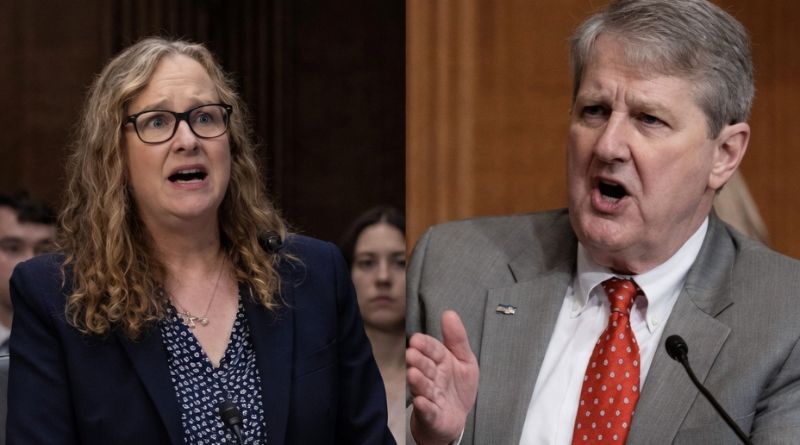
In a recent viral exchange that has captured the attention of viewers across the nation, Senator John Kennedy found himself in a heated debate with a progressive professor on the controversial issues surrounding former President Donald Trump and his supporters.
The video, titled “I’ve SEEN What You’ve Done To Trump’s People,” showcases a clash of ideologies that has become increasingly common in today’s political discourse.
As the tension escalates, viewers are left wondering: How did we arrive at such a polarized state of conversation in America?
The backdrop of this exchange is a nation grappling with deep divisions.
On one side stands Senator Kennedy, a seasoned politician known for his sharp wit and no-nonsense approach.
On the other side is a professor whose views reflect the growing influence of progressive thought in academia.
Their discussion touches on critical topics such as freedom of speech, the role of government in regulating discourse, and the implications of social media on public perception.
From the outset, it’s clear that both parties have come prepared to defend their positions.
Senator Kennedy, with his characteristic Southern charm, opens the dialogue by questioning the professor’s stance on the treatment of Trump’s supporters.
“Have you ever considered the consequences of your words?” he asks, his voice steady yet probing.
The professor responds with a passionate defense of his beliefs, arguing that the actions taken against Trump and his allies were justified in the name of justice and accountability.
As the conversation unfolds, viewers witness a back-and-forth that is as enlightening as it is contentious.
Kennedy challenges the professor on the concept of “wokeness,” questioning whether it fosters genuine dialogue or stifles dissenting opinions.
The professor, in turn, argues that it is essential to address systemic injustices, even if it means confronting uncomfortable truths.
The exchange has sparked a wave of reactions online, with many viewers applauding Kennedy for his articulate defense of free speech.
Others have criticized the professor for what they perceive as an inability to engage with opposing viewpoints.
Comments on social media range from supportive to scathing, highlighting the divide that this conversation has illuminated.
What Does It Mean for America?
This confrontation raises significant questions about the future of political discourse in the United States.
Are we moving toward a society where open dialogue is replaced by echo chambers?
Or can we find a way to bridge the gap between differing ideologies?
As the video continues to circulate, it serves as a reminder of the importance of engaging in difficult conversations, even when they become uncomfortable.
In a time when political polarization seems to be at an all-time high, the exchange between Senator Kennedy and the WOKE professor serves as a microcosm of the larger struggles facing our society.
It challenges us to reflect on our own beliefs and the ways we engage with those who think differently.
Ultimately, it is through these dialogues that we can hope to understand each other better and move toward a more cohesive society.
As viewers continue to dissect the exchange, one thing is clear: the conversation is far from over.
The implications of this debate will resonate long after the final words have been spoken.
In a world where every voice matters, it is crucial that we listen, learn, and strive to find common ground.
After all, in the words of Senator Kennedy, “We may not always agree, but we must always engage.”
And that is the essence of democracy.