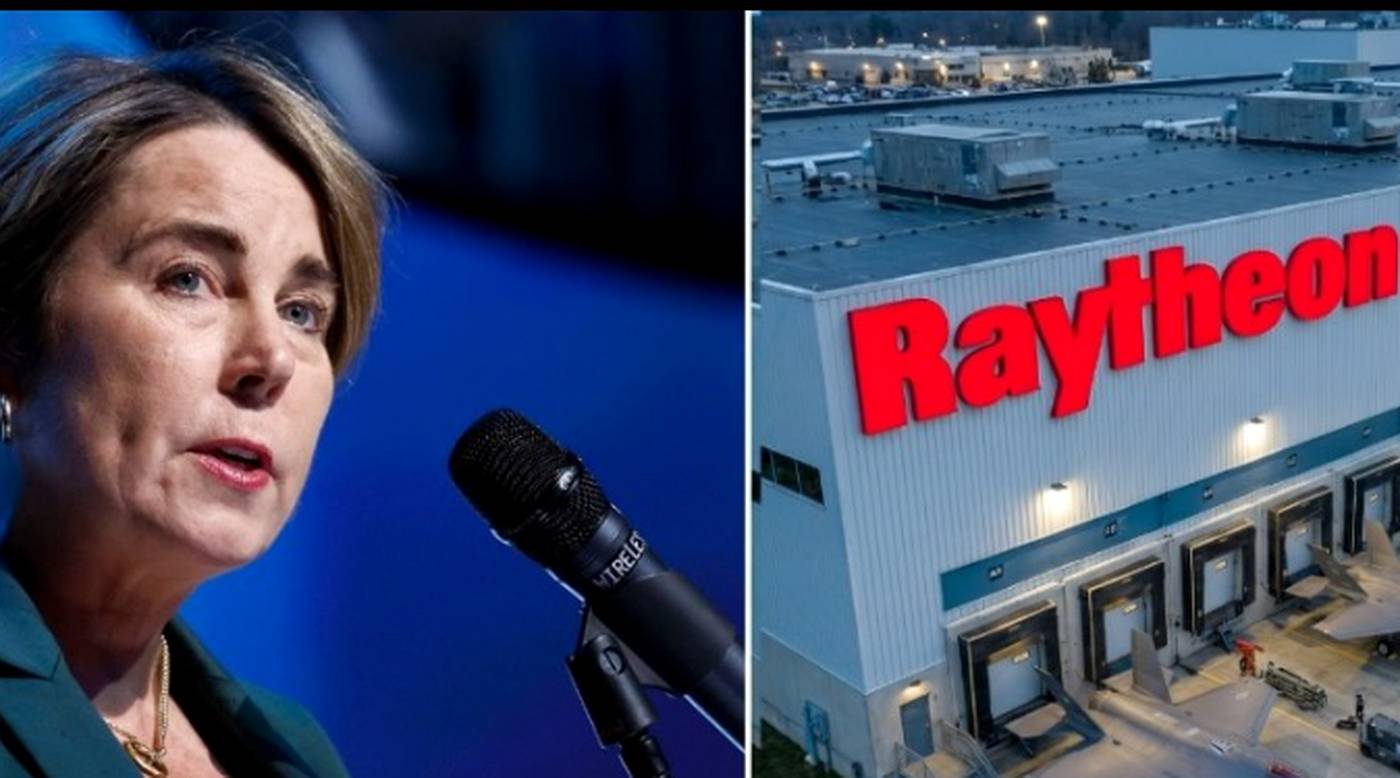
From Cambridge to Virginia: The Corporate Shift That’s Raising Alarm Bells Across Massachusetts
What appears on the surface as a corporate restructuring decision is, to many
A quiet but powerful shift in America’s defense landscape is unfolding, and its effects are being felt most sharply in Massachusetts, a state that has long considered itself one of the foundational pillars of the country’s aerospace and defense industry.
What appears on the surface as a corporate restructuring decision is, to many observers, a symbolic turning point in a century-long relationship between a state and one of its most iconic defense contractors.
For more than a hundred years, the company now known as RTX carried deep historical ties to Massachusetts.
Over the decades, its presence expanded across the region, anchoring entire
Its origins trace back to Cambridge in the early 1920s, where engineering innovation and defense research helped shape technologies that would go on to influence global military strategy.
Over the decades, its presence expanded across the region, anchoring entire communities economically and socially.
Towns like Andover, Waltham, Tewksbury, and Marlborough grew alongside its facilities, benefiting from high-paying engineering jobs, supplier contracts, and the ripple effects of a thriving industrial base.
Northern Virginia, in particular, has emerged as one of the most important hubs
But in recent years, the geography of American defense has been changing. Slowly at first, then with increasing momentum, key decision-making centers within major defense companies have been shifting closer to Washington, D. C. , where federal agencies, Pentagon leadership, and policy influencers are concentrated.
Northern Virginia, in particular, has emerged as one of the most important hubs for aerospace and defense firms in the country.
The announcement that RTX would consolidate its headquarters functions in Arlington, Virginia, did not happen in isolation.
For Massachusetts, however, the move carries an especially heavy symbolic
It followed a broader pattern in which major defense and aerospace companies have increasingly gravitated toward the capital region.
For Massachusetts, however, the move carries an especially heavy symbolic weight, given the company’s century-long history in the state and its role in shaping the local economy.
What is particularly significant about headquarters relocation is that it goes far beyond a simple change of address.
When those functions move, the gravitational pull of the entire ecosystem begins
Corporate headquarters serve as the strategic brain of an organization. They house senior executives, influence major contracting decisions, and shape long-term investment priorities.
When those functions move, the gravitational pull of the entire ecosystem begins to shift with them.
Industry experts point out that defense contracting is uniquely sensitive to proximity. Relationships with federal agencies, lobbying presence, program oversight, and access to decision-makers all play critical roles in securing and maintaining billion-dollar defense programs.
As those networks concentrate in Northern Virginia, companies naturally begin
image
As those networks concentrate in Northern Virginia, companies naturally begin aligning their leadership structures closer to where key decisions are made.
For Massachusetts, the concern is not an immediate collapse but a gradual erosion of influence.
However, the strategic layer — where long-term direction is set — is
The state still retains significant operations, including engineering centers and manufacturing facilities, which continue to employ thousands of skilled workers.
However, the strategic layer — where long-term direction is set — is increasingly located elsewhere.
This shift has prompted growing debate among policymakers, economists, and industry analysts about whether Massachusetts is doing enough to maintain its competitiveness in high-value industries like defense and aerospace.
Supporters of current policies counter that Massachusetts remains a global
Critics argue that structural challenges such as high housing costs, energy prices, and regulatory burdens are making it harder for companies to justify maintaining large leadership footprints in the state.
Supporters of current policies counter that Massachusetts remains a global leader in innovation, research, and education, and that its ecosystem continues to attract top engineering talent.
At the same time, other states have become increasingly aggressive in recruiting defense and aerospace firms.
Texas, Arizona, Alabama, and Florida have also expanded their presence in
Virginia has built a dense ecosystem around Pentagon adjacency, offering infrastructure, incentives, and workforce pipelines tailored to defense needs.
Texas, Arizona, Alabama, and Florida have also expanded their presence in aerospace manufacturing, missile systems, and advanced defense technologies.
These regions are not simply competing; they are strategically positioning themselves as long-term hubs for national security industries.
Defense contracting is deeply interconnected
As these shifts accelerate, the concern in Massachusetts is not just the loss of a single headquarters function but the potential cascading effect on the broader industrial base.
Defense contracting is deeply interconnected. Prime contractors rely on thousands of smaller suppliers, precision machinists, software developers, and engineering firms.
When major decision centers move, those networks often begin to realign over time. Some local businesses already report increasing uncertainty about long-term contracts, while workforce trends show engineers and technical professionals gradually relocating to lower-cost or more strategically positioned regions.
In neighboring New Hampshire and other nearby states, there has been noticeable growth in engineering and manufacturing employment tied indirectly to Massachusetts-originating firms.
State officials, meanwhile, face a difficult balancing act. Efforts to retain large employers often involve negotiations over tax incentives, infrastructure investments, and workforce development programs.
However, structural constraints limit how quickly a state can respond to corporate relocation pressures. Housing shortages, transportation bottlenecks, and long-term fiscal policies cannot be adjusted overnight, even when economic urgency is high.
This reality has led to growing concern among some policymakers that Massachusetts may be entering a new phase in its economic evolution, one where legacy industries that once defined the state are no longer anchored as firmly as they once were.
Historically, Massachusetts has experienced similar transitions. The decline of textile manufacturing in Lowell and Lawrence, the contraction of shipbuilding in Quincy, and the restructuring of industrial corridors along Route 128 all marked earlier shifts in the state’s economic identity.
Each transition brought short-term disruption but also paved the way for new industries, particularly in technology, biotechnology, and higher education.
The question now is whether defense and aerospace will follow a similar trajectory or whether the current shift represents a more structural relocation of strategic control outside the region.
For the communities most directly tied to RTX operations, the uncertainty is deeply felt. These are not abstract economic indicators but real jobs, real families, and long-standing local economies built around stable employment in engineering and manufacturing.
The presence of major defense contractors has historically provided not only employment but also stable tax bases that fund schools, infrastructure, and public services.
As leadership functions migrate, local leaders are increasingly focused on how to retain talent and maintain industrial activity within the state.
Workforce development programs, partnerships with universities, and innovation grants are all part of a broader effort to sustain competitiveness.
Yet even with these initiatives, the scale of national-level industry realignment presents a significant challenge.
The broader defense industry itself is also evolving. Modern warfare technologies increasingly rely on software, artificial intelligence, cybersecurity, and space systems.
This shift has intensified competition for highly specialized technical talent, further increasing the importance of geographic clustering near government and defense decision centers.
As a result, proximity to Washington, D. C. Has become more than just convenient; in many cases, it is strategically advantageous.
This has reinforced Northern Virginia’s position as a dominant hub, attracting not only RTX but also other major aerospace and defense firms seeking alignment with federal priorities.
Whether this trend continues at its current pace remains uncertain. Corporate location decisions are influenced by a complex mix of economics, politics, workforce availability, and long-term strategy.
While Massachusetts remains a powerhouse in education and innovation, it now faces the challenge of ensuring that its industrial base keeps pace with national shifts in defense geography.
What is clear, however, is that the movement of headquarters functions represents more than just corporate logistics.
It signals a deeper realignment of influence within one of America’s most critical industries. For Massachusetts, the implications extend beyond economics into questions of identity, legacy, and future direction.
As the situation continues to develop, attention will remain fixed on whether the state can adapt quickly enough to retain its position within the defense ecosystem or whether this moment marks the beginning of a longer-term transition toward a new national map of industrial power.
The story is still unfolding, and its full consequences have yet to be written.