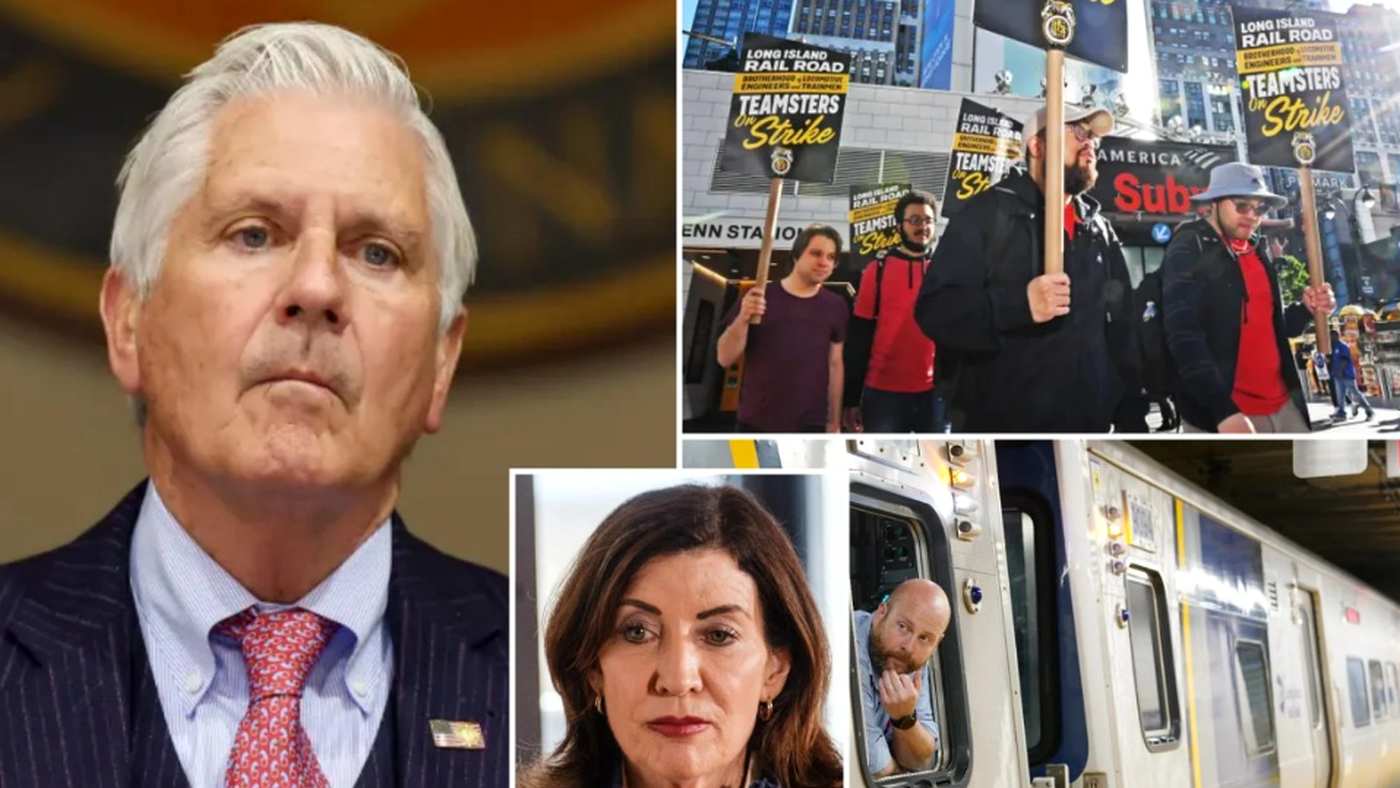
🚨 New York On The Brink: Hochul Under Fire As Massive Rail Strike Threatens Chaos
New York woke up staring into the possibility of complete commuter chaos as tensions surrounding the Long Island Rail Road strike exploded into a full-scale political war.
What began as a labor dispute rapidly spiraled into
Accusations, finger-pointing, economic panic, and fierce attacks aimed directly at Governor Kathy Hochul’s leadership.
With hundreds of thousands of commuters potentially stranded, businesses bracing for devastating financial losses, and political rivals seizing the moment, the crisis has become far bigger than delayed trains.
It has become a brutal public battle over who is truly responsible for pushing New York toward another breaking point.
The warning signs had been building for weeks, but now the
Threat feels immediate. A “manic Monday,” as some commentators described it, suddenly carried an entirely new meaning.
Across Long Island and New York City, anxious workers prepared for the possibility that their daily commute could collapse overnight.
Stations that usually pulse with predictable routine were instead filled with uncertainty, anger, and fear.
For many New Yorkers, the Long Island Rail Road is not merely
Transportation. It is the lifeline that connects families to jobs, students to schools, and entire communities to the economic heartbeat of the state.
As the strike threat intensified, Governor Kathy Hochul found herself trapped at the center of an escalating storm.
Critics accused her administration of failing to maintain strong relationships with labor unions, while supporters argued that federal labor complications limited what the state could actually do.
The confusion only fueled public frustration. Was this a
Federal issue? A state issue? Or simply a catastrophic failure of leadership?
Into that chaos stepped Nassau County Executive and gubernatorial candidate Bruce Blakeman, who unleashed a blistering attack against Hochul during a fiery television interview that immediately ignited political debate across social media and cable news.
Blakeman did not hold back. He declared that the strike represented “a lack of leadership” from Hochul and portrayed New York as a state collapsing under economic pressure, high taxes, and poor management.
According to him, the governor had mishandled relationships
With workers while simultaneously spending billions elsewhere.
He painted a grim picture of New York’s condition. Electric bills soaring far above the national average.
Economic rankings falling behind other states. Workers growing increasingly frustrated. Businesses struggling under crushing costs.
In his view, the rail strike was not an isolated incident but
Rather the latest symptom of a deeper crisis spreading through New York under Hochul’s administration.
The political tension escalated even further when blame shifted toward the White House and President Donald Trump.
Hochul allies suggested federal labor law complications played a major role in limiting state control over the situation.
But Blakeman fiercely rejected that argument, accusing Hochul
Of using Trump as a political scapegoat.
His remarks quickly turned explosive. He argued that Trump had done more for New York “as a private citizen” than previous federal leadership had accomplished while in office.
He mocked the governor’s repeated criticisms of Trump and claimed she blamed him for nearly every crisis imaginable.
The comments instantly fueled outrage online, deepening the
Already toxic political divide surrounding the strike.
Yet beyond the politics, ordinary New Yorkers were left facing an increasingly terrifying reality. Financial experts warned that a prolonged shutdown could cost the state more than $60 million per day.
The potential damage stretched far beyond delayed trains. Restaurants, retail stores, office buildings, delivery systems, and small businesses all risked severe disruption.
For countless workers living paycheck to paycheck, even a few
Days of commuting chaos could trigger financial disaster.
Traffic experts predicted highways could become overwhelmed if rail passengers were forced into cars, buses, or rideshares.
Long Island’s already congested roads threatened to transform into gridlocked nightmares. Some commuters began scrambling for hotel rooms near workplaces, while others desperately searched for remote work options.
Social media erupted with frustration. Some users blamed union
Leadership for pushing negotiations to the brink.
Others directed fury toward Hochul, accusing her administration of ignoring worker concerns until the crisis exploded publicly.
Meanwhile, political activists on both sides weaponized the strike as proof of broader failures in government leadership.
The labor dispute also revived memories of previous strikes and labor conflicts across New York.
Blakeman referenced earlier confrontations involving nurses and correction officers, arguing that Hochul handled those crises by bringing in outside workers or National Guard assistance rather than building lasting partnerships with unions.
Whether voters agreed with his criticism or not, one reality became undeniable: trust between government leadership and organized labor appeared dangerously fragile.
Union workers themselves increasingly became the emotional center of the story. Many argued they were not demanding luxury, but fairness.
Rising inflation, housing costs, and economic pressure have battered working-class families across New York. For rail workers operating in one of the most expensive states in America, the contract battle became symbolic of something larger — respect, security, and survival.
Blakeman leaned heavily into that argument, claiming workers felt abandoned while billions of taxpayer dollars were spent elsewhere.
He specifically referenced controversial spending priorities tied to migrant programs and progressive political initiatives, arguing that hardworking union families were being left behind.
Those claims, unsurprisingly, ignited immediate backlash from Hochul supporters, who accused critics of exploiting economic anxiety and politicizing a labor dispute for electoral gain.
But as politicians battled on television screens, commuters prepared for what could become one of the worst transportation disruptions New York has seen in decades.
Inside train stations, uncertainty hung in the air. Riders refreshed news feeds repeatedly, hoping negotiations might somehow produce a last-minute breakthrough.
Some feared losing wages if they could not reach work. Others worried about childcare schedules collapsing.
For many families, the stress was immediate and personal. Transportation analysts warned that even a temporary strike could create ripple effects lasting weeks.
Delayed shipments, missed business meetings, canceled appointments, and tourism disruptions could all pile onto an already fragile economic environment.
And politically, the timing could not have been worse for Hochul. New York voters have increasingly voiced concerns over affordability, crime, migration pressures, and infrastructure problems.
The image of stranded commuters and economic paralysis risks becoming a devastating symbol for critics eager to challenge Democratic leadership in upcoming elections.
Blakeman clearly understands that opportunity. Throughout the interview, he positioned himself as a leader capable of working directly with unions and avoiding confrontation.
He emphasized negotiation, partnership, and mutual respect, portraying Hochul as disconnected from everyday workers. Whether voters accept that argument remains uncertain.
But politically, the strike has already transformed into more than a labor issue. It is now a referendum on leadership itself.
Meanwhile, transportation officials continued racing against time behind closed doors. Negotiators faced enormous pressure to prevent a catastrophic shutdown.
Every passing hour increased public anxiety. Every failed negotiation update intensified media scrutiny. The looming possibility of hundreds of thousands of commuters stranded simultaneously created a sense of ticking-clock urgency that dominated headlines across New York.
For many residents, exhaustion also played a role. After years of economic instability, inflation, pandemic disruptions, staffing shortages, and political division, another large-scale crisis felt almost unbearable.
Some commuters described feeling trapped in a state constantly lurching from one emergency to another.
Yet others defended the workers, arguing that without pressure tactics, labor concerns are too often ignored until systems collapse.
That tension lies at the heart of the crisis. Is the strike an irresponsible disruption hurting innocent commuters?
Or is it the unavoidable consequence of leadership failures that pushed workers to the edge?
As negotiations dragged forward, no easy answers emerged. What remained undeniable, however, was the sheer scale of the stakes involved.
New York’s transportation system is one of the largest and most critical in America. Even small disruptions send shockwaves across the economy.
A full-scale rail shutdown threatens not only commuters but the image of New York itself as a functioning economic powerhouse.
And hovering over everything was politics. Every statement became ammunition. Every delay became a headline.
Every frustrated commuter became a symbol in a larger war over the future direction of New York.
The strike threat may ultimately end with a negotiated agreement. Trains may return. Stations may refill with normal morning routines.
But the political damage from this confrontation could linger far longer. Because for millions watching this unfold, the crisis exposed something deeper than delayed transportation.
It exposed a state struggling to hold together under pressure. And as commuters waited anxiously for answers, one question echoed louder than all the others:
Who will New Yorkers blame if the system finally breaks?