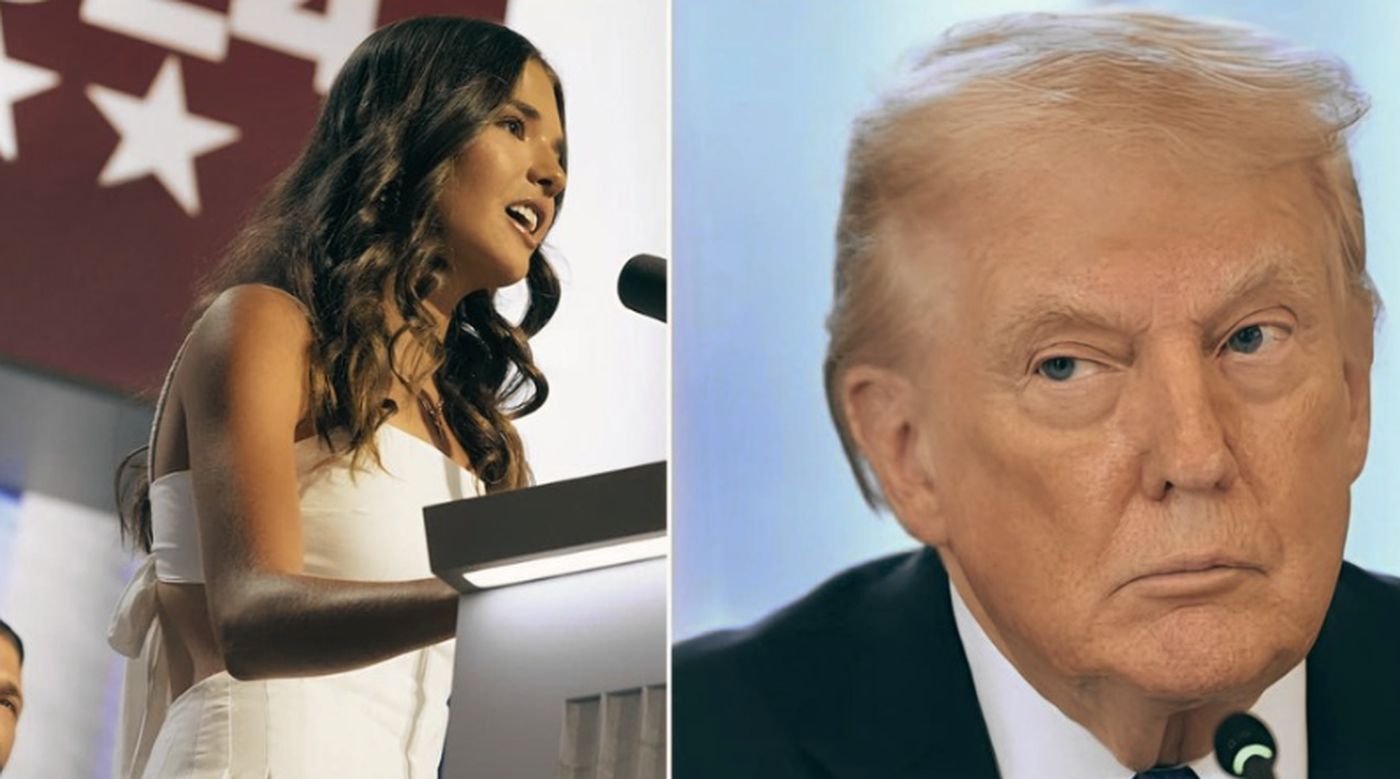
In an era where public figures are often defined by headlines, polling numbers, and political narratives, a recent moment involving Kai Trump offered something strikingly different. It was not dramatic, not strategic, and not designed for attention. Yet it resonated precisely because of its simplicity.
During a public announcement tied to her future at the University of Miami, Kai spoke briefly about her journey and those who supported her along the way. Among those acknowledgments, she turned to her grandfather, Donald Trump, and expressed gratitude in a way that immediately stood out.
Her words were not filled with grand praise or elaborate storytelling. Instead, they reflected something more grounded—appreciation for access, opportunity, and consistent support. In a public environment often dominated by carefully constructed messaging, this moment felt unfiltered. It did not attempt to persuade or impress. It simply revealed.
What made the moment notable was not just what was said, but what it implied. Behind a figure as widely known and debated as Donald Trump exists a private role that is rarely discussed in detail: that of a grandfather. In Kai’s brief acknowledgment, there was an implicit portrait of that role—one defined not by public power, but by personal presence.
Access to golf courses, guidance, and encouragement may seem like small details on the surface.
But within the context of a young athlete shaping her future, those elements become meaningful. They represent time, attention, and a willingness to invest in someone else’s growth without expectation of recognition. Kai’s words suggested that these gestures were not occasional, but consistent.
Moments like this challenge the tendency to view public figures through a single lens. Political identity often overshadows every other aspect of a person’s life, reducing complex individuals to simplified narratives. Yet family interactions—especially those shared voluntarily and without apparent agenda—can offer a different kind of insight.
For Kai, the moment was about gratitude. For observers, it became something more layered.
It invited reflection on how influence operates beyond formal roles. While policies and decisions shape nations, quieter forms of influence—mentorship, encouragement, and presence—shape individuals in ways that are less visible but equally lasting.
It is also worth noting the setting in which this occurred. A milestone announcement for a young person stepping into a new chapter is, by nature, a personal moment. By choosing to include her grandfather in that narrative, Kai framed his role not as symbolic, but as active. She did not speak about legacy or status. She spoke about support.
There is a broader cultural relevance in this as well. In a time when visibility is often equated with value, the idea of contributing quietly—without public acknowledgment—carries a different kind of weight.
Kai’s decision to speak those words publicly suggests an awareness that such contributions, while private, still matter enough to be recognized.
Ultimately, the significance of this moment lies in its contrast to the noise that typically surrounds public life. It was not amplified by controversy or driven by spectacle. Instead, it stood out precisely because it was understated.
In that brief exchange, a different narrative emerged—one that does not replace existing perceptions, but adds dimension to them. It serves as a reminder that behind every public identity are private relationships that operate on entirely different terms.
And sometimes, it takes just a few honest words from a granddaughter to bring that reality into focus.